Wednesday, February 6, 2008

Château Mission Haut-Brion/Grand Cru Classé de Graves/Pessac-Leognan


Dear Readers,

Everybody will admit, we can not avoid to speak about Chateau La Mission Haut-Brion even if Chateau Haut-Brion is in fact cross the road.

On the 2nd of November 1983, Domaine Clarence Dillon S.A., already owner of Chateau Haut-Brion, bought Chateau La Mission Haut-Brion from the descendants of the Woltner family. Twenty years later, under the presidency of the Duchesse de Mouchy, daughter of the Hon. Douglas Dillon, former Ambassador to France and Secretary of the Tresury under President Kennedy, Chateau La Mission Haut-Brion pursues a lengthy program of quiet renovation. A new cuvier that was built in 1987, the chateau which has been entirely modernized and a new chai worthy of La Mission, all bear witness to this desire for perfection.
Today, a new generation watches over the destiny with his mother, the Duchesse de Mouchy, oversees the management of the properties belonging to Domaine Clarence Dillon S.A..


We have a chance to visit their cellar ahd they use only new casks at 100% every year in the winemaking process.
The average time for ageing is 22 months.
Vine varieties:
Merlot noir 45%
Carbernet Franc 7%
Cabernet Sauvignon 48%
Average age of vines: 19 years old.


Tasting room at Ch. La Mission Haut-Brion below:

Chateau La Mission Haut-Brion 2004: intense by the nose, complex with notes of smoke, tobacco and roasted coffe grains but still a pleasant fruit. A well-balanced wine and a great seducer for this vintage.

Thank you very much for this great visit. Sante,
MFM


Château Haut-Brion/1er Grand Cru Classé/Pessac-Leogan


Dear Pessac-Leognan lovers,

Here, we are in February 2008 and extremely pleased to visit one of most well-known and recognized chateau of Pessac-Leognan estate "Chateau Haut-Brion". Today, the continuity and presence of the Dillon family are ensured, for the next generation, by Prince Robert of Luxembourg who watches over the destiny of Domaine Clarence Dillon S.A. alongside his mother, the Duchess de Mouchy.


We started by their cellar on your left. At Chateau Haut-Brion, all the first wine is put into new casks for a period of twenty months. This use of new barrels goes back to the beginning of the 18th century, to a time when the old, poorly maintained casks used to contaminate the new wine and irreparably spoil it.


Ch.Haut-Brion 2001 tasting: a very good year (weather conditions were fairly similar to those 2000), dense and youthful color and for a young wine, the aromas jump out of the glass.

Thanks again for your warm welcome. Cheers!
MFM

Tuesday, February 5, 2008

Château Latour/1er Grand Cru Classé/Pauillac

Dear Bordeaux Connoisseurs,

Early February, I had the privilege with Cuvelier house to visit some of greatest vineyards started with"Château Latour", 1st classified growth of Pauillac, Bordeaux . The history of château Latour began in 1378. In 1670, Ségur family bought its great domain and kept it until 1963. From 1963 to 1993, the domain was owned by the British. And, in 1993 the Château went back to the French as it was bought over by Mr.Francois Pinault.


We saw the different steps for making process of this prestigious wine.


Above all, the paradise cellar will astonish you by the reserve of very old vintages.


Then, we ended-up by the tasting room surrounded by the vineyards (below) where we tasted their 3 wines (Pauillac de Latour 2006, Les Forts de Latour 2003 and Grand Vin de Château Latour 2001) conducted by Ms.Sonia Favreau.


*Pauillac de Latour 06:
49% Cabernet Sauvignon,
45% Merlot,
6% Petit Verdot.

Average ageing (vineyards): 10 years old

Floral and fruity.


*Les Forts de Latour 03:
78% Cabernet Sauvignon,
22% Merlot.

Average ageing (vineyards): 35 years old

Fresh, dense and complex.


*Grand Vin de Château Latour 01:
79% Cabernet Sauvignon,
18% Merlot,
1% Cabernet Franc,
2% Petit Verdot.

Average ageing (vineyards): 50 years old


Very pure and very elegant, not its usual strengh but an interesting suppleness.


We would like to thank you for your warm welcome.

Cheers!
MFM

Château Lafite-Rothschild/1er Grand Cru Classé/Pauillac


Dear Friends and Pauillac connoisseur,

The first known reference to Lafite dates to 1234 with a certain Gombaud de Lafite, abbot of the Vertheuil Monastery north of Pauillac, Lafite’s mention as a medieval fief dates to the 14th century.

The name Lafite comes from the Gascon language term “la hite”, which means “hillock”. There were probably already vineyards on the property at the time when the Ségur family organised the vineyard in the 17th century, and Lafite began to earn its reputation as a great winemaking estate. Jacques de Ségur is credited with the planting of the Lafite vineyard in the 1670’s and in the early 1680’s. In 1695, Jacques de Ségur’s heir, Alexandre, married the heiress of Château Latour, and they gave birth to Nicolas-Alexandre de Ségur. The fiefs of Lafite and Latour were thus unified at the beginning of their estate legacy

On 8 August 1868, Baron James de Rothschild purchased Château Lafite, which had been placed under public sale through the inheritance of Ignace-Joseph Vanlerberghe.

The Barons de Rothschild recovered possession of Château Lafite Rothschild at the end of 1945, and Baron Elie was responsible for recovering the estate’s business. In 1975, Baron Eric de Rotschild, nephew of Baron Élie, took his place. Today, Charles Chevallier is the technical director of the Domaines.

We started our tour by the room of this big oak vat and followed by first cellar. Don't forget, The barrels are all made at the Domaine’s cooperage.


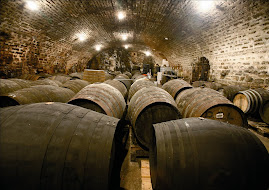
The ageing phase of the wine begins in the chai, which takes between 18 and 20 months. Here, it is below. We are inside the famous cellar which could be used for an Opera.


We ended-up by an extraodinary tasting with a comparaison of two vintages 1994 and 2006.

*Château Lafite-Rothschild 1994
99% Cabernet sauvignon
1% Petit Verdot
Average ageing (vineyards): 30 years old
Pure and fresh.

*Château Lafite-Rothschild 2006
82% Cabernet sauvignon
16% Merlot
2% Cabernet Franc
Fine and elegant.


We would like to thank you for this great visit and tasting.

MFM


Château Margaux/1er Grand Cru Classé/Margaux


Dear Margaux lovers,

Here we are, in presence of 1st classified growth of Margaux: Château Margaux. We can not start a visit without a little history about this wine of excellence.
At the end of the 17 century, Château Margaux became part of the nascent elite "First Growths" long before established officially by the classification of 1855. Today, it is linked most closely to the work of Mr.André Mentzelopoulos who became the owner in 1977. After he passed away, his daughter Corinne Mentzelopoulos took over and she and her team still devote the same deep for this magnificient place.


First, we went through their enormous oak vats where a fermentation process will take 3 weeks. Then, the cellar of ageing the wines (beside) for a period of 18 to 24 months in a new oak barrels.


Above, the other cellar below which was trully an experience due to its size and architecture.


Finally, we finished our visit by a tasting conducted by a young lady Ms. Marie Meunier.

Château Margaux 2004:
Cabernet sauvignon 75%
Merlot 20%
Petit verdot and Cabernet franc 5%

Average ageing (vineyards): 35 years old.

Floral, dense and a classic margaux


Once again, we would like to thank for your welcome.

MFM

Château Mouton-Rothschild/1st Grand Cru Classé/Pauillac


Dear Pauillac lovers,

Yes, after this great visit we ended-up our tour by one a famous 1st classified growth in Pauillac: Château Mouton-Rotschild.


Back to the legacy of this very well-known and influent family in the Bordeaux scene, this is mainly
what you should know:

In 1853, an English member of the Rothschild family, Baron Nathaniel de Rothschild, purchased the property then called Chateau Brane-Mouton and renamed it Chateau Mouton-Rothschild.
In 1922, his great grandson, the legendary Baron Philippe, took its destiny into his own hands, and gave it a new start.

The sixty years of his ownership bear, the stamp of his strong personnality, his entrepreneurial flair and his sens of innovation.

In 1924, he initiated the hitherto unusual practice of bottling all production at the Chateau. This innovation brought with it the need for more storage capacity.
In 1926, he built the famous 100 meter long "Grand Chai".
In 1945, Baron Philippe conceived the original idea of crowning the Mouton label with a work of art created for this purpose by famous artists: Miró, Chagall, Braque, Picasso, Warhol, Bacon, Balthus, among others.
In 1962, he created at Mouton the "Museum of Wine in Art" which displays a priceless collection of art works relating to wine and the vine.

After a twenty-year battle, Baron Philippe obtained a revision of the 1855 Classification and in 1973, Mouton-Rothschild became officially a Premier Cru Classé.
Since her father's death in 1988, Baroness Philippine has assumed control of Mouton-Rothschild, enhancing still further its quality and reputation around the world.

Of course, we have at least to give an overview about this incredible history. During the visit, we went to see every steps of making


We also had these two special moments during this exquisite visit:


First one, when we arrived inside the paradise reserve where they kept a fantastic selection of vintages.


Second one, when we did taste the vintage 2006.
87% Cabernet Sauvignon
13% Merlot

It was really on the fruit, pleasant and very elegant.


We would like to thank you for your warm welcome again.

Cheers!

MFM

Friday, January 25, 2008

Gaja Family Estates


Dear Italian wines defenders,

As some of you probably noticed, I was in Italy this month of January 2008. This time, I took along with me a great translator "Rosella Sabouraud" (below) I couldn't find better tranlastor than a native speaker which is my mother and she is from Torino to meet some differents wineries mostly in the Piedmont region.

In fact, we will focus into one "Gaya". We arrived in the afternoon at Gaya winery in the center of Barbaresco village and Mr.Stefano Canello (Mr. Angelo Gaya relative's, right side) conducted the visit.

Going back to their history, you have to know that Gaja family settled in the piedmont region in the northwest Italy in the mid-seventeenth century. Four generations of Gajas have been producing wines in Piedmoont's Langhe hills since 1859, the year Giovanni Gaja, a local grape grower, founded the Gaja Winery in Barbaresco.

Today, The Gaja winery owns 250 acres of vineyards in the Barbaresco district (Barbaresco and Treiso) and the Barolo district (Serralunga d'Alba and La Morra). In 1988, they acquired a 30 acre vineyard in one of Serralunga's best areas and named it Sperss, which means in Piedmontese for nostalgia. It refers to the Gaja family's nostalgia for the powerful character of Serralinga wines. So, this wine is Langhe Nebbiolo DOC 94% Nebbiolo and 6% Barbera. We are in presence of a deep structure, the nose is pure and very focused fruit with a touch of truffles. Ageing will be 12 months in barriques then 12 months in large Oak casks.
In 1994, the Gayas acquired their first wine estate in Tuscany, Pieve S.Restituta in Montalcino. The property's forty acres of vineyards produce two brunello di Montalcino wines: Sugarille and Rennina.

In 1996, the Gaya family purchased a second property in Tuscany, Ca'Marcanda, located in the bolgheri district in the commune of Castagneto Carducci. New plantings of Merlot and Cabernet Sauvignon as well as Cabernet Franc, Syrah and Sangiovese cover 250 acres. The wines produced at Ca'Marcanda are Promis, Magari and Camarcanda (below). The 2000 vintage is the first release of each of these wines.


This is wine is Bolgheri DOC, 50% Merlot, 40% Cabernet Sauvignon and 10% Cabernet Franc. It is very complex and well-structured, nose with rich fruit. Ageing 18 months in new barriques, then at least 12 months of bottle ageing.

We would like to thank you for you warm welcome.
Saluti and Grazie!
MFM

Tuesday, January 22, 2008

Château d'Issan/3e Grand Cru Classé Margaux


Dear Margaux lovers,

I had the privilege to meet Mr.Emmanuel Cruse owner of Ch. D'Issan (right above), 3rd classified growth in Margaux. Chateau d'Issan is located at the entrance of the village of Cantenac.
In 1945, the Cruse family purchased the property and since then Issan revealed its true potential. Today, the heirs of Emmanuel Sr and Marguerite Cruse run the estate with the true passion and continue to make improvements in both vineyards and the technical aspects of winemaking.

After a wonderful lunch at the chateau, we started our visit through the cellars conducted by Mr.Cruse, himself.

Following vinification, the wines are meticulously tasted and barrels are set aside for blending, one batch at the time.


And so begins the slow ageing of the wine during 18 months in oak barrels.Château D'Issan has become synonymous with the Charm, Suppleness and Finesse which are the hallmarks of its great terroir of 300 acres. This is an authentic Margaux (65% Cabernet-Sauvignon-35% Merlot)

In 1995, a second wine was born Blason d'Issan made from the youngest vines on the property blended with juice from fully mature vines. It will be perfect for those who wants to get a first step in the world of great Margaux.

I would like to thank again Mr.Emmanuel Cruse and his staff for their warm welcome.

Santé!
MFM